The Marketing Machine
How Much of Your Dollar Goes to a Brand's Marketing
At Hims & Hers, 39 cents of every dollar it brought in last year went to marketing. At P&G, about 11 cents went to advertising.


Hims & Hers spent 39 cents of every dollar it brought in last year on marketing.
When you hand a brand a dollar, how much pays for the product, and how much pays for the marketing that got you to buy it?
At some brands, it's close to 40 cents.
Do you ever wonder where the price differences come from between Bayer Aspirin and CVS’ store brand?
If so, you’re not alone. In 2014 economists studied this and found pharmacists, the shoppers who know headache remedies best, chose the national brand only 9% of the time. The average shopper chose it 26% of the time.
So what makes Bayer and CVS store brand different?
Part of it is the brand, and the marketing behind it: more money is being spent to get people to buy than ever before, and part of that cost is built into what shoppers pay. We’ll dive into how much, where it goes, and how to tell whether you are paying for the product or the marketing machine behind it.
How much of every dollar goes to marketing?
It depends on the company, and on who you're paying.
Start with Hims & Hers, which sells tele-health prescriptions and wellness products directly to consumers. When you buy from a direct-to-consumer brand, your dollar goes straight to the brand. In 2025, Hims & Hers spent $919 million on marketing on $2.35 billion in revenue. A whopping 39%! Most of it, $799 million, went to finding new customers: display, search, streaming and TV ads, affiliates, radio and podcasts, and a Super Bowl campaign.
Now compare that to Procter & Gamble, the company behind Pampers and Gillette. In its 2025 fiscal year, P&G spent $9.2 billion on advertising against $84.3 billion in net sales. That's about 11% of revenue, and it doesn't include consumer promotions, product samples or sales aids, which P&G tracks separately. But P&G sells mostly through stores and online retailers, so its revenue is what those retailers pay it, not what you pay at the register. Of your dollar at checkout, P&G's advertising takes less than 11 cents.
So does 39 cents of every dollar you spend with Hims & Hers go to ads? Not exactly. These are company-wide numbers, not a line on your receipt, and marketing covers more than ads. But they show the scale: when a company spends 11% to 39% of its revenue convincing people to buy, that money comes out of what its customers pay.
Why are companies spending more to reach shoppers?
Because there's more money in advertising than ever, and most of it goes to a handful of platforms. WPP Media projects global ad revenue, excluding U.S. political ads, will grow 8.9% this year to $1.3 trillion. As a share of the global economy, that's the highest it's been since 1999. And the three biggest sellers outside China, Alphabet, Meta and Amazon, control 57.6% of the market.
Those platforms are also making more from each of us. In 2025, Meta earned $57.03 for every person who used its apps daily, up 15% from the year before. Its daily users were up 6.9% year over year by the end of 2025. When revenue per person grows about twice as fast as the number of people, advertisers are paying more to reach each one of us.
Influencer posts and podcast ads read by hosts
Ads aren't just TV commercials anymore. They include nano-influencers, normal people with a few thousand followers, and the host-read podcast ads that direct-to-consumer brands buy.
If you listen to podcasts, you’ve almost certainly heard about Quince. The direct-to-consumer brand, best known for inexpensive cashmere, was the biggest podcast advertiser in the second quarter of 2026, spending an estimated $19 million in three months, according to Magellan AI. Most of Quince's podcast ads are read by the hosts themselves: Podscribe found 86% of them were host reads in June 2026. In March 2026, Quince raised $500 million at a $10.1 billion valuation.
Some of these tactics went far enough that regulators stepped in. Since October 21, 2024, an FTC rule has banned buying or selling fake followers or views, like the ones generated by bots or hijacked accounts, to make someone look more influential for commercial purposes.
Remember, a creator's recommendation can be part of a marketing budget, even when it doesn't look like an ad.
Don't people just skip the ads?
More of us do, and the spending keeps going up anyway. Eyeo, a company that makes ad-filtering software, estimates more than 1 billion people now use an ad blocker, and mobile ad blocking is up 27% since 2023. A separate GWI survey found that 29.5% of internet users worldwide, and 32.5% of Americans, use one.
Both numbers are climbing at the same time. An ad budget gets spent whether or not you see the ad, and it's still paid for out of what customers spend. Skipping the ad doesn't take its cost out of the price.
Why are name brands more expensive than store brands?
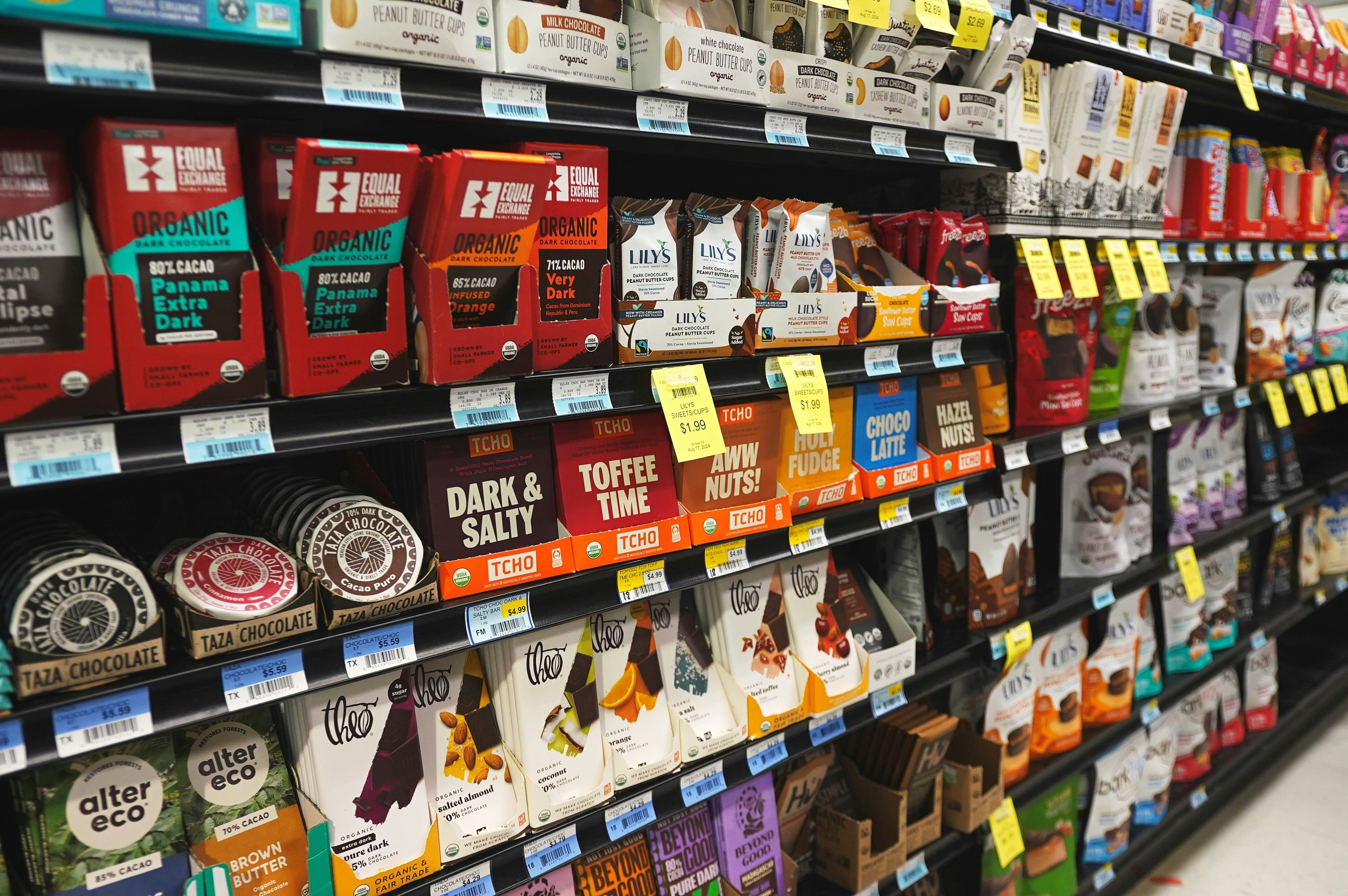
Because part of what you're paying for is the brand itself. Economists call it the brand premium: the extra you pay for a national brand over a store brand that's the same product.
Remember the pharmacists? The same study looked at chefs too. Chefs put 12 percentage points less of their pantry-staple purchases, things like salt and sugar, toward national brands than similar non-chefs did.
The researchers estimated that, at the time of the study, shoppers spent $196 billion a year in categories where a store-brand alternative existed, and could have spent about $44 billion less by switching whenever they could (NBER). They also found that misinformation explains a sizable share of the premium for health products, and much less of it for most food and drink.
So here's a rule that works for anything you buy: when two products are the same underneath, the price difference is the cost of the brand, and part of that is the cost of persuading you.
You might also like